
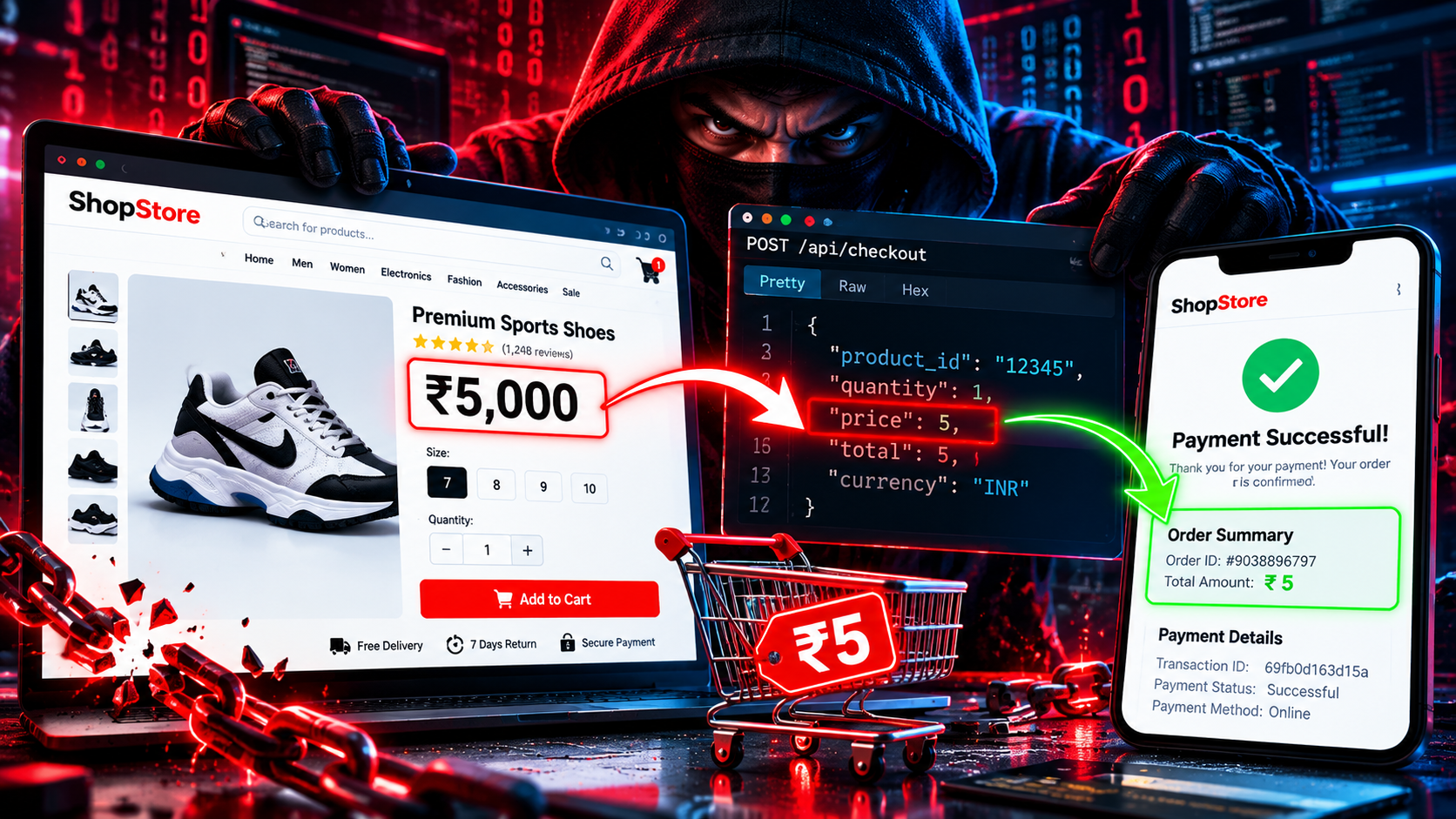
Is Your Website Charging the Correct Price?
When customers purchase a product online, they expect the displayed price to match the amount charged at checkout. For businesses, this is equally important: every order must be calculated correctly, every payment must be verified, and every transaction must be recorded accurately.
But what happens when the amount displayed in an order confirmation does not match the expected order value?
Price manipulation is an important security concern for e-commerce websites. If an application relies on untrusted price values or fails to validate the complete checkout process, an attacker may be able to exploit weaknesses in its business logic.
During a client security assessment, CyberNexora identified a concern involving an e-commerce order confirmation that displayed a total amount of ₹1 alongside a successful payment status. This observation highlighted the importance of examining how the application calculates order totals and verifies payments.
The key question was not simply what the webpage displayed, but whether the application’s backend and payment records consistently validated the correct amount.
What Did the Security Assessment Reveal?
The order confirmation evidence showed a successful-payment message and a total amount of ₹1. This warranted a closer examination of the relationship between the expected order value, the amount processed by the application and the payment status recorded for the transaction.
A confirmation page alone does not prove that the payment gateway settled the transaction for ₹1 or that a product was delivered for that amount. Those outcomes must be verified using the corresponding order and payment records.
Nevertheless, the observation illustrates a critical security principle: an application should never treat a displayed price or success message as sufficient proof that a transaction is valid.
The server must independently validate the order amount and confirm the payment before accepting the order as paid.
Assessment Evidence
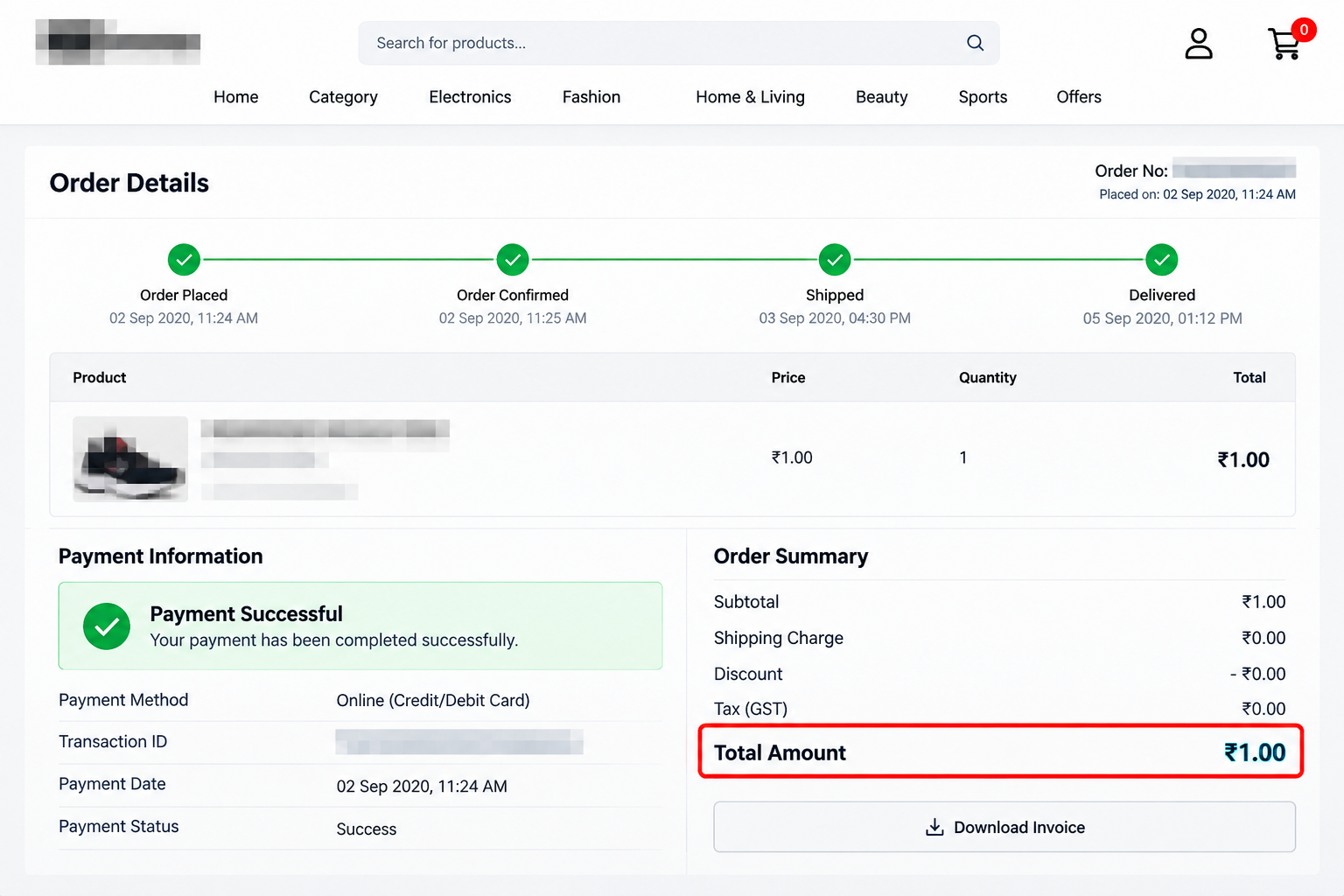
Suggested image: A cropped, blurred screenshot of the relevant order summary showing the displayed total amount and payment status. Hide the client name, domain, order ID, transaction ID, customer details and any other identifying information.
Suggested image alt text: E-commerce order confirmation showing the displayed order total and payment status during a security assessment
What Is Price Manipulation?
Price manipulation is a business-logic security weakness in which an application may accept or process a price or order total that differs from the value authorized by the business.
Consider an illustrative example: a pair of shoes is listed for ₹5,000. During checkout, a weakness in the application’s validation logic allows the order total to be processed as ₹5 instead.
A properly secured application should reject an unauthorized amount and calculate the final price using trusted server-side product and order data.
This does not mean that every difference in price is a vulnerability. Legitimate discounts, promotional offers and pricing rules can change an order total. The security concern arises when an amount is accepted without the required authorization and validation.
Price manipulation can affect more than product prices. Depending on the application, weaknesses may involve discounts, coupon codes, shipping fees, taxes, quantities or the total amount submitted during checkout.
How Price Manipulation Can Occur
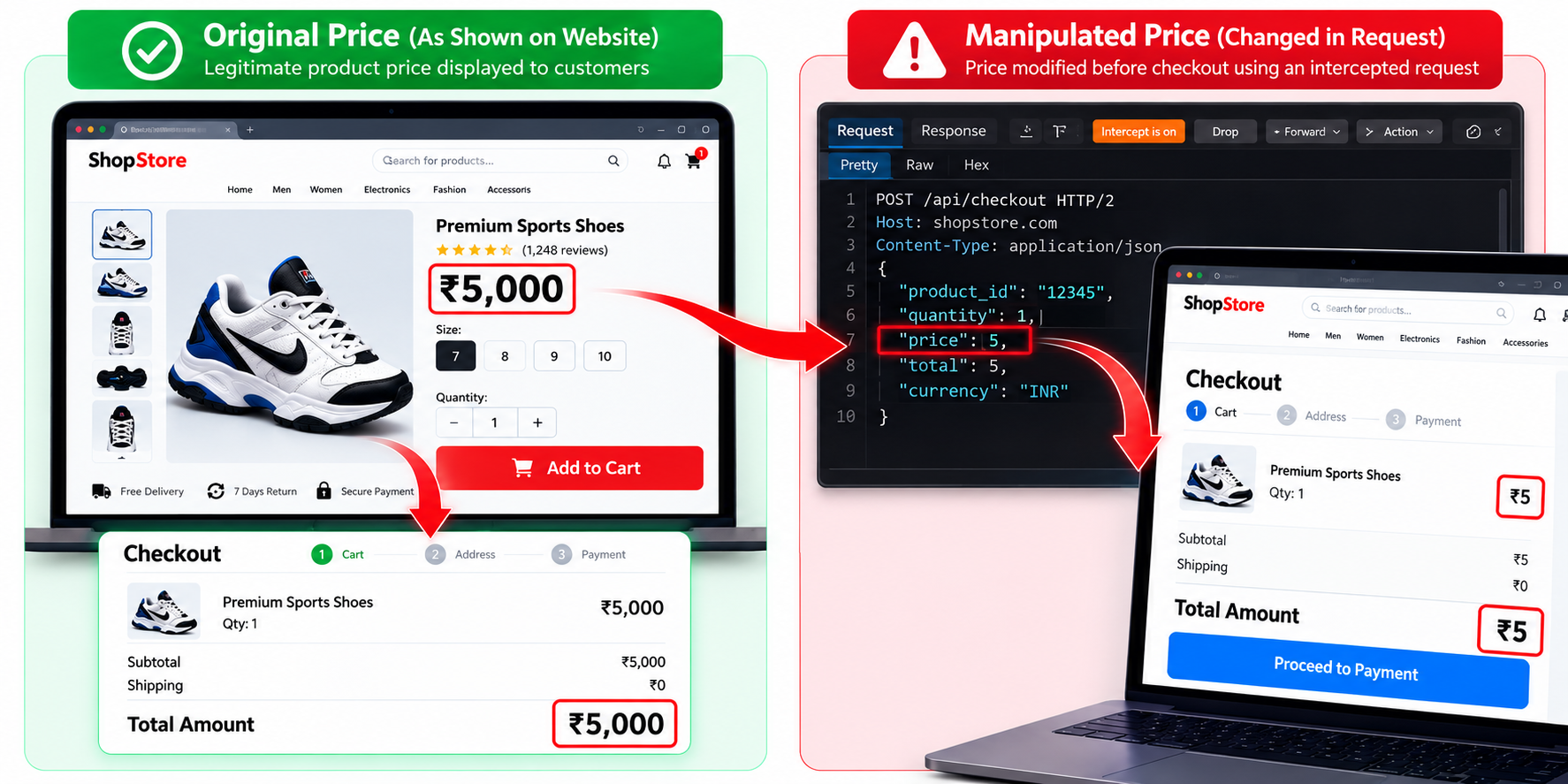
Suggested image: A clean, professional security illustration with two side-by-side panels. The first shows a product listed at ₹5,000; the second shows an unexpected checkout total of ₹5, with a clear warning that the example is illustrative. Avoid presenting a simulated image as actual client evidence.
Suggested image alt text: Illustration explaining how an e-commerce price-validation weakness could cause an incorrect checkout total
Why Can This Become a Serious Business Problem?
A checkout vulnerability may appear to affect only one amount on one order. However, if the underlying weakness is exploitable, its consequences can extend across the business.
Financial loss: Products or services may be sold for less than their authorized value if incorrect amounts are accepted.
Order and inventory issues: Orders could enter fulfilment workflows even when their payment amounts have not been properly validated.
Accounting discrepancies: The order total recorded by the application may not match the amount confirmed by the payment provider.
Customer disputes: Incorrect totals, inconsistent receipts or unexpected charges can create confusion and lead to support requests.
Damage to customer trust: Customers expect online transactions to be accurate and reliable. Repeated payment or pricing discrepancies can affect confidence in a business.
Operational overhead: Investigating suspicious transactions, reconciling payment records and reviewing affected orders can consume time and resources.
The actual business impact depends on whether the weakness can be exploited, how the application processes orders and which controls are already in place.
Does Using a Third-Party Payment Gateway Make Your Website Secure?
Not automatically.
A payment gateway can provide secure payment-processing capabilities, but the merchant’s website remains responsible for handling prices, building payment requests and updating order status correctly.
For example, a website may display the expected price on its product page but still contain weaknesses in how it validates the final amount. Similarly, displaying a payment-success message does not, by itself, establish that the backend has verified the transaction.
A secure checkout should ensure that:
- The server calculates the final order amount using trusted pricing data.
- The payment request uses the correct amount and currency.
- The confirmed payment is matched to the corresponding order.
- The order is marked as paid only after the appropriate verification succeeds.
- Unverified payment events cannot trigger fulfilment or create inconsistent order records.
Payment security depends on the entire checkout flow-not just the payment gateway.
What Should Businesses Do to Prevent Price Manipulation?
Preventing price manipulation requires consistent validation across the complete order lifecycle.
1. Calculate Prices on the Server
Product prices and final order totals should be calculated on the server using trusted product records. The application should not rely on a price or total merely because it was submitted by the browser.
2. Validate Discounts and Additional Charges
Coupons, promotional discounts, shipping charges and taxes should be checked against the business’s rules. The server should recalculate the final amount before initiating payment.
3. Match the Payment to the Order
The amount and currency confirmed by the payment provider should match the expected amount and currency for the relevant order. Any mismatch should be investigated rather than automatically accepted.
4. Verify Payment Before Confirming the Order
The application should use the payment provider’s recommended server-side verification process. A browser redirect or a success message alone should not be treated as definitive proof of payment.
5. Protect Order Processing
The application should prevent duplicate payment notifications or repeated requests from causing duplicate fulfilment, inconsistent order states or incorrect payment records.
6. Monitor Unexpected Transactions
Businesses should securely record relevant order and payment events and investigate unexplained differences between expected totals and confirmed payments. Logs should be designed to protect sensitive customer and payment information.
7. Conduct Security Testing and Retesting
Authorized security testing can help identify weaknesses in price validation, payment verification and order processing. After remediation, the application should be retested to confirm that incorrect amounts are rejected while legitimate transactions continue to work correctly.
Image 3 – Secure Checkout Validation
[INSERT IMAGE HERE – Secure E-commerce Payment Flow Diagram]
Suggested image: A simple, professional diagram illustrating this flow:
Product & Pricing Data → Server-Side Order Calculation → Payment Request → Payment Verification → Order Confirmation
Include a rejection branch for an amount mismatch. Keep the diagram focused on the security process rather than decorative hacker imagery.
Suggested image alt text: Secure e-commerce checkout flow with server-side price calculation and payment verification
How CyberNexora Helps Businesses Identify These Risks
CyberNexora provides web application and API Vulnerability Assessment and Penetration Testing (VAPT) to help businesses discover security weaknesses in their websites and online workflows.
For e-commerce platforms, an authorized assessment can examine:
- Product price and order-total validation
- Coupon, discount and shipping calculations
- Checkout request handling
- Payment verification and transaction consistency
- Order-status and fulfilment logic
- Relevant web application and API vulnerabilities
Findings can be documented with supporting evidence, an assessment of the potential impact and practical remediation recommendations, within the agreed engagement scope.
The goal is not simply to find a technical flaw. It is to help businesses understand where their online processes may be exposed and what needs to be strengthened.
Is Your E-commerce Checkout Protecting Your Business?
If your website accepts online payments, there is one important question to ask:
Can you verify that the price calculated by your server, the amount processed by your payment provider and the final order record always match?
A website can look perfectly normal while still having weaknesses in its underlying business logic. Routine browsing and successful test purchases are not substitutes for security testing.
Checking these controls can help businesses reduce preventable pricing errors, strengthen payment workflows and maintain customer confidence.
Do not wait for a transaction discrepancy to investigate your checkout security.
Contact CyberNexora to discuss an authorized web application and payment-flow security assessment.
Website: https://cybernexora.com/
Frequently Asked Questions
What is an e-commerce price manipulation vulnerability?
It is a weakness that may allow an application to accept or process a product price or order total that differs from the authorized amount.
Can a payment gateway alone prevent price manipulation?
No. The merchant’s application must also calculate prices correctly, create payment requests securely and verify the confirmed transaction against the expected order.
How can a business check whether its website is vulnerable?
An authorized VAPT assessment can examine price calculations, checkout requests, discount logic, payment verification and order processing to identify weaknesses.
Does a successful-payment message prove that the correct amount was paid?
No. The application should verify the transaction against authoritative payment records, including the amount, currency, status and associated order.
When should an e-commerce website be tested?
Testing is particularly valuable before launching a payment-related change, after modifying checkout logic or payment integrations, and periodically as the application evolves.
Technical References
These resources provide general security guidance. The actual exploitability and business impact of the specific observation must be established from the assessment evidence and relevant transaction records.